Structural steel fabrication in NC, SC and VA typically costs $800 to $1,800 per ton in 2026 for shop work alone. Simple cut-and-drill components run near $800; complex FCAW-welded assemblies with QC inspection reach $1,500–$1,800. Fabricated and erected, most commercial packages land between $3,500 and $6,500 per ton.
Every commercial project eventually reaches the same question: how much will the structural steel cost? Most estimators start with the structural steel fabrication cost per ton. It is a useful number for early budgeting, but it is often misunderstood. A single figure can hide very different scopes, and two bids with the same per-ton price may include completely different work.
At Richards Metal Fabrication, we fabricate and erect structural steel for multifamily, hotel, hospital and commercial projects across North Carolina, South Carolina and Virginia. From our shop in Dunn, NC, we price steel packages every week for general contractors and developers. In this guide, we break down what drives fabrication cost in 2026, what each service costs per ton, how steel compares with competing materials, what lead times to expect, and what information you need to get an accurate quote.
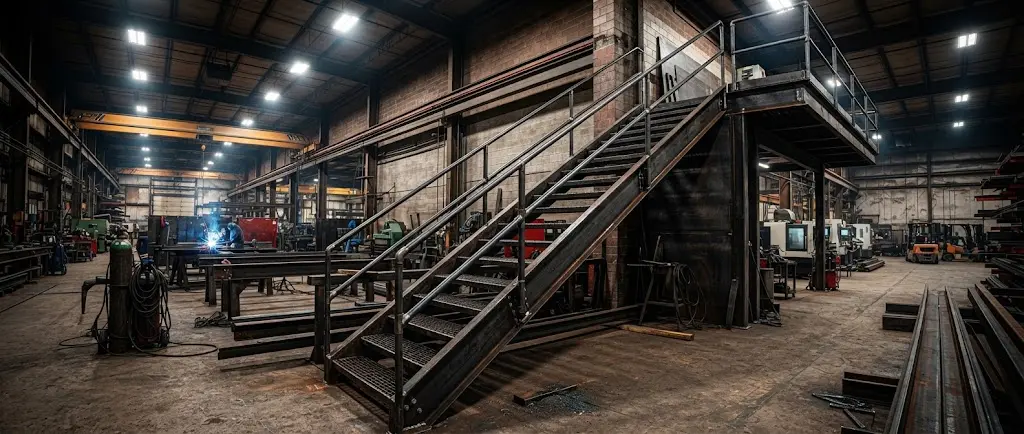
What Drives Structural Steel Fabrication Cost in the Southeast?
Quick Answer: Five factors drive most of the price: component complexity, steel grade, the processes each piece requires, order volume and delivery distance. Complexity matters most, because steel is bought by weight but fabricated by the hour. Connection count, copes, stiffeners and welding can double the shop hours on the same tonnage.
1. Component Complexity
In our shop, the biggest cost driver we see is connection count, not tonnage. Every shear tab, moment connection, brace gusset and stiffener requires cutting, fitting, welding and inspection. A heavy column with simple end plates may take less shop time than a light beam with copes, stiffeners and multiple connections. Lighter members also mean more pieces per ton, which adds handling, piece marks and shop drawings.
2. Material Grade: A36 vs A572 Grade 50
Most wide flange shapes are produced today to ASTM A992, while plate and angle are commonly specified as A36 or A572 Grade 50. Higher-strength grades can carry a modest material premium, but they may also reduce member sizes and total tonnage. The grade must match the structural drawings exactly, so it should always be confirmed before pricing.
3. Required Processes: CNC Only vs CNC + FCAW + QC
A component that only needs CNC cutting, drilling and coping sits at the low end of the range. Once fit-up, flux-cored arc welding (FCAW) and documented QC inspection are added, the labor per ton rises sharply. Welded assemblies such as built-up members, moment frames and stair stringers consistently land at the upper end.
4. Order Volume and Repetition
Repetition lowers cost. When the same member sizes and connection details repeat across floors, setup time is spread over more tons. Small orders with many unique pieces carry a higher per-ton price because setup, programming and handling stay nearly the same regardless of quantity.
5. Delivery Distance From Dunn, NC
Freight is charged by distance and load type. Oversized members may need escorts and permits, so haul distance from our facility in Dunn, NC affects the final number on larger packages.
How Location Changes the Number in NC, SC & VA
In North Carolina, strong multifamily, healthcare and life sciences activity in Raleigh-Durham and Charlotte keeps demand for erection crews high. In South Carolina, coastal projects around Charleston and Myrtle Beach face higher wind design loads and more demanding corrosion protection, while Upstate industrial work trends lower. In Virginia, Northern Virginia carries higher labor and logistics costs, while Richmond and Hampton Roads fall closer to Carolina pricing.
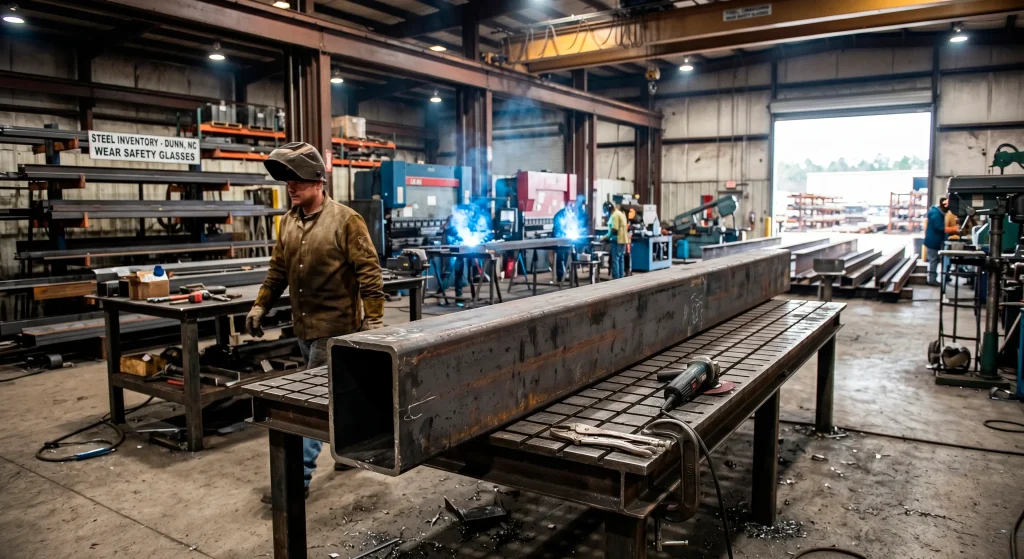
Cost Breakdown by Service — What You’re Actually Paying For
Quick Answer: A per-ton fabrication price is the sum of distinct shop services. In 2026, CNC processing typically runs $250–$450 per ton, fit-up and FCAW welding $300–$850, QC inspection and documentation $75–$200, and staging and freight $75–$300. Mill material, detailing, coatings and erection are priced as separate lines.
The table below shows typical planning ranges for commercial structural steel fabrication in the Carolinas and Virginia. These are budgeting figures, not quotes.
| Service | Typical Range Per Ton (2026) | What It Includes |
|---|---|---|
| CNC Processing | $250 – $450 | CNC cutting, drilling, coping, layout marking |
| Fit-Up and FCAW Welding | $300 – $850 | Fitting, structural welding per AWS D1.1, stiffeners and connections |
| QC Inspection | $75 – $200 | In-process and final inspection, weld documentation, NCR control |
| Staging and Freight | $75 – $300 | Sequencing, loading, trucking and oversize permits |
| Shop fabrication total | $800 – $1,800 | Excludes mill material, detailing, coatings and erection |
From Fabrication Price to Installed Price
Many bids quote an installed price instead. This is how a typical installed number builds up:
| Cost Component | Typical Range Per Ton (2026) |
|---|---|
| Steel material (wide flange, HSS, plate, angle, bolts) | $1,100 – $1,600 |
| Detailing and shop drawings | $150 – $400 |
| Shop fabrication (table above) | $800 – $1,800 |
| Shop primer | $100 – $300 |
| Field erection (crew, crane, bolting, field welding) | $900 – $2,000 |
| Typical installed total | $3,500 – $6,500+ |
Galvanizing as an Add-On
When specifications call for hot-dip galvanizing, budget roughly $500 to $1,000 per ton above a primed price, plus transport and turnaround time to the galvanizer. For guidance on choosing the right system, see our article on how to prevent corrosion on structural steel.
How Steel Market Prices Affect Your Number
Mill pricing and tariff policy influence the material line. Section 232 tariffs on imported steel, raised significantly in 2025, continue to shape domestic pricing. Even so, material is usually the smaller share of the installed price. A 10% swing in mill prices moves the total far less than a change in connection design or erection sequence.
Cost by Project Type
| Project Type | Typical Installed Range Per Ton | Why |
|---|---|---|
| Low-rise retail, warehouse, light industrial | $3,500 – $4,500 | Simple gravity framing, repetitive members |
| Multifamily podium and mid-rise | $4,200 – $5,500 | Transfer beams, more connections, tight sites |
| Hotels and hospitality | $4,300 – $5,700 | Fast schedules, mixed spans, canopies |
| Hospitals and healthcare | $5,000 – $6,500+ | Heavy frames, vibration criteria, strict QA |
Structural Steel Cost vs. Competing Materials in 2026
Quick Answer: For commercial framing in the Southeast, structural steel usually offers the best balance of cost, speed and flexibility. Precast concrete competes on parking structures and highly repetitive floors, while aluminum costs significantly more per ton and is reserved for canopies, sunshades and corrosion-sensitive elements. Steel’s shorter lead times often decide the comparison.
| Material | Typical Cost Basis | Typical Lead Time | Advantages for B2B Projects |
|---|---|---|---|
| Structural steel | $3,500 – $6,500 per ton fabricated and erected | 2 – 10 weeks of shop fabrication after approvals | Fast erection, long spans, easy future modification, AISC-verified quality |
| Precast concrete | Priced per square foot or per piece | Commonly 12 – 20 weeks including plant scheduling | Built-in fire resistance, durability, efficient for parking decks |
| Aluminum | Significantly higher per ton than steel; priced per piece or system | Commonly 6 – 12 weeks depending on extrusions | Lightweight, naturally corrosion resistant, suited to coastal accents |
For most multifamily, hotel and hospital framing, steel’s combination of speed and adaptability keeps it the default choice. Precast becomes competitive when layouts are highly repetitive, and aluminum is best used selectively rather than as primary framing.
Lead Times From Our Dunn, NC Facility
Quick Answer: From our Dunn, NC facility, shop fabrication typically takes 2 to 6 weeks for component orders and smaller packages, and 4 to 10 weeks for mid-size commercial packages, once drawings are approved and material is in hand. Compressed schedules add overtime, split deliveries and extra crane mobilizations, which raise cost per ton.
| Phase | Typical 2026 Window | Cost Risk When Compressed |
|---|---|---|
| Shop drawings and approvals | 3 – 6 weeks | Extra detailing hours, revision cycles |
| Material procurement | 2 – 8 weeks | Premium service-center pricing |
| Shop fabrication | 2 – 10 weeks | Overtime, second shifts |
| Erection | Per sequence plan | Additional crane mobilizations |
Our guide on managing lead times in structural steel explains how to protect these windows and avoid schedule premiums. When deliveries arrive in erection sequence and pieces fit the first time, crews set more tons per day and the erection cost per ton drops.
H2: What Information Do You Need to Get an Accurate Quote?
Quick Answer: To quote structural steel fabrication accurately, we need design files in CAD, DXF or DWG format (or PDF drawings), a bill of materials or cut list, material grade, quantity, finish requirements and the required delivery date. Complete information removes contingency from the price and shortens our response time.
Before you request pricing, gather the following:
- Design files: CAD, DXF or DWG files, or a current PDF drawing set (permit or IFC).
- Bill of materials or cut list: member sizes, lengths and quantities.
- Material grade: A992, A36, A572 Grade 50 or as specified.
- Quantity and phasing: total tonnage and how it will be released.
- Finish requirements: bare, shop primer, galvanizing or special coatings.
- Delivery date and site logistics: target schedule, laydown and access constraints.
- Specifications: Division 05 sections such as 05 12 00 and 05 50 00, including connection design responsibility.
- Compliance requirements: AISC certification, AWS D1.1 and any testing or inspection criteria.
Missing information forces fabricators to add contingency, which inflates prices or creates exclusions that resurface later as change orders.
Certification and Hidden Inspection Costs
Price only matters if the fabricator can deliver as specified. When a fabricator is not approved by the building official, IBC Section 1704.2.5 generally requires special inspection of shop work, billed to the project and rarely visible in the per-ton bid. Our breakdown of AISC certified vs non-certified fabricators explains how this affects total cost, and a solid subcontractor prequalification process prevents low bids from turning into expensive problems.
How to Lower Your Cost Per Ton Without Losing Compliance
- Standardize connections: fewer connection types mean faster fitting and fewer errors.
- Repeat member sizes: consolidated sizes reduce procurement cost and waste.
- Match coatings to exposure: reserve galvanizing for exterior or corrosive conditions.
- Favor bolted field connections: field welding is slower and requires more inspection.
- Separate miscellaneous metals: price stairs and railings as their own line items.
The best savings appear during design development, before connections are finalized. Once drawings are issued for construction, changes cost more and save less.
Frequently Asked Questions
Quick Answer: These are the cost questions general contractors, developers and procurement teams ask us most often when budgeting structural steel fabrication in North Carolina, South Carolina and Virginia. Each answer is brief and direct so your team can use it during preconstruction, budgeting and bid leveling.
How much does structural steel fabrication cost per ton in North Carolina in 2026?
In North Carolina, structural steel fabrication costs range from $800 to $1,800 per ton for shop work, depending on component complexity, material grade and required processes. Simple CNC-processed components run closer to $800 per ton; complex welded assemblies with QC inspection reach $1,500–$1,800 per ton. Material and erection are priced separately.
What factors affect structural steel fabrication pricing in the Southeast?
The main cost drivers are component complexity, steel grade (A36 vs A572), required processes (CNC only vs CNC plus welding and QC), order volume and delivery distance. AISC-certified shops may carry a slight premium but eliminate costly rework and compliance failures on commercial projects.
Does AISC certification affect the cost of structural steel fabrication?
AISC-certified fabricators often carry a 5–10% premium over non-certified shops, but this is typically recovered through reduced rework, cleaner inspections and fewer project delays, especially on commercial projects in NC, SC and VA where AISC compliance is specified.
Can I get a structural steel fabrication quote without a full set of drawings?
Yes. We review preliminary cut lists, bills of materials and sketch-level specifications to provide budget ranges before final drawings are complete. Submit what you have, and our estimating team will respond with a preliminary estimate you can use for early procurement planning.
What is the lead time for structural steel fabrication in the Southeast?
Lead times from our Dunn, NC facility are typically 2–6 weeks for component orders and smaller packages, depending on scope and current shop load. For time-sensitive projects in NC, SC and VA, submit files as early as possible so our estimating team can advise on scheduling from day one.
Conclusion
Quick Answer: Structural steel fabrication cost per ton in NC, SC and VA is a planning tool, not a final price. Shop fabrication typically runs $800 to $1,800 per ton, and the installed number depends on material, coatings, schedule and site conditions. Complete documents shared early turn a range into a reliable budget.
The structural steel fabrication cost per ton gives your team a starting point, but the projects that stay on budget are the ones that look beyond the average. Understanding what sits inside each dollar per ton, from CNC processing and FCAW welding to QC, freight and erection, helps you level bids fairly, spot exclusions early and make smarter design decisions.
At Richards Metal Fabrication, we combine AISC certified fabrication with in-house erection for multifamily, hotel, hospital and commercial projects across North Carolina, South Carolina and Virginia. Explore our structural steel fabrication and erection services to see how we deliver clear, scope-complete pricing.
Ready for a real number? Submit your cut list or drawings to Submit Files for a Quote, email terry@richardsmetalfabrication.com or call our team.