Richards Welding fabricates and installs commercial railings for projects in Charlotte, NC and the surrounding metro area. We produce custom steel and aluminum guardrails, handrails and stair railings that meet IBC code requirements for commercial buildings, fabricated in Dunn, NC and delivered to Charlotte.
Table of Contents
What Should You Know About Commercial Railings Charlotte, NC?
Key takeaways
- Commercial railings in Charlotte must meet IBC Sections 1014 and 1015, plus the ADA Standards where accessible routes apply.
- Guards must be at least 42 inches high, and handrails must sit 34 to 38 inches above the stair nosing.
- Richards Welding supplies both steel and aluminum railing systems from its shop in Dunn, NC.
- The Dunn shop is approximately a 2-hour drive from Charlotte, with in-house delivery and installation.
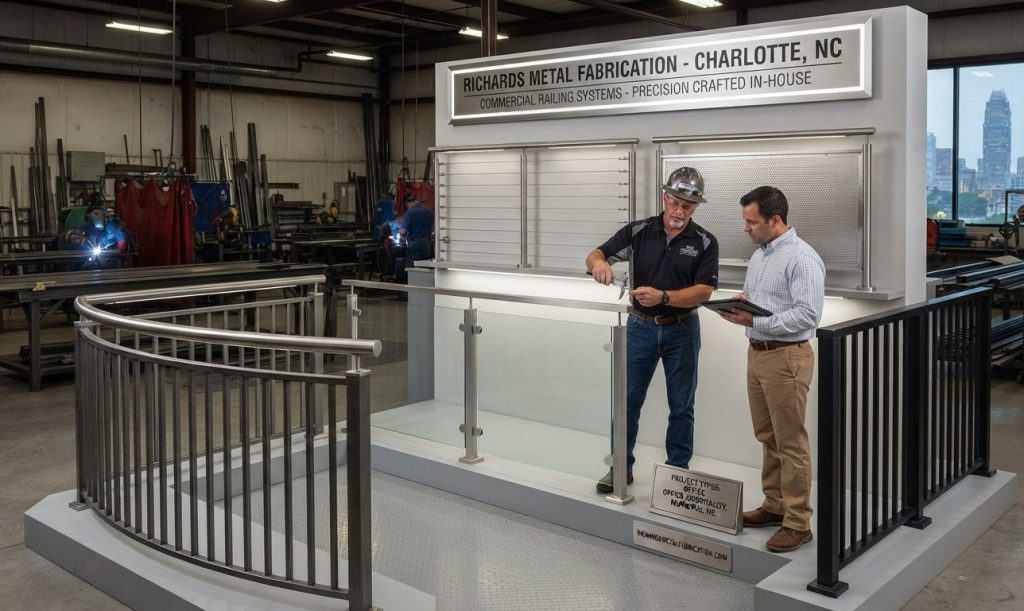
Types of Commercial Railings We Fabricate for Charlotte Projects
Richards Welding fabricates guardrails, handrails, stair railings and custom decorative railings for Charlotte commercial projects. Each type serves a different safety function and follows its own code section. Choosing the right type depends on where the railing sits and who uses it.
| Railing type | Typical material | Common use | Applicable code |
| Guardrails | Steel picket, pipe or square tube | Open sides of stairs, landings, mezzanines, podium decks | IBC 1015 |
| Handrails | Steel pipe or tube, wall-mounted or post-mounted | Stairs and ramps on accessible routes | IBC 1014, ADA 505 |
| Stair railings | Steel guardrail with attached handrail | Egress stairs in multi-story buildings | IBC 1011, 1014, 1015 |
| Custom decorative railings | Steel or aluminum | Lobbies, balconies, hotel corridors | IBC 1015 plus design specs |
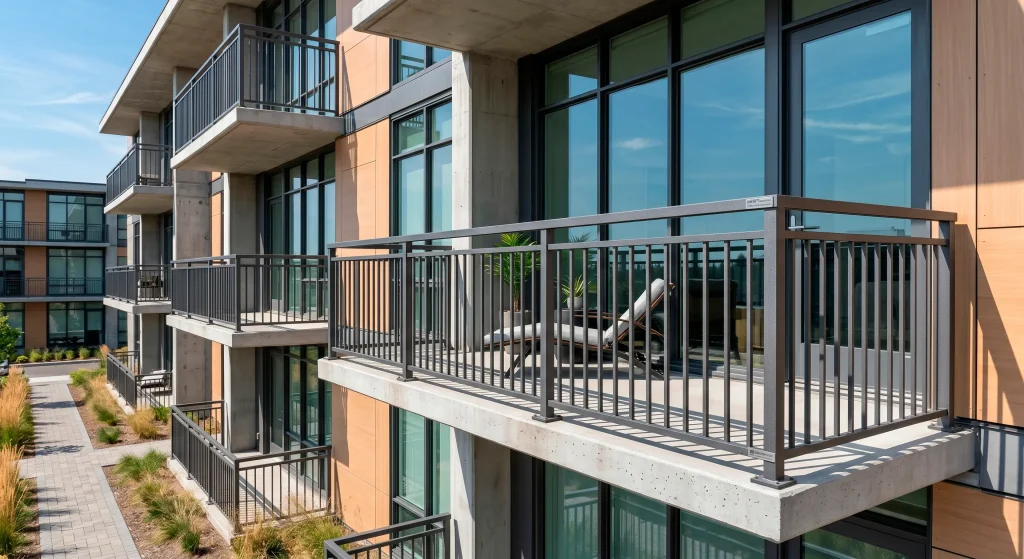
| Exterior railing systems | Aluminum | Balconies, breezeways, exterior walkways | IBC 1015, AWS D1.2 |
Industrial-style railings prioritize strength and simple pipe or tube profiles. Decorative railings in Charlotte hotels and multifamily lobbies add custom infill and finishes. Both must pass the same load and dimensional checks.
IBC and ADA Code Requirements for Commercial Railings in NC
Commercial railings in North Carolina must follow the North Carolina State Building Code, which is based on the IBC, plus the 2010 ADA Standards on accessible routes. The key requirements cover guard height, opening size, handrail height, graspability and structural load.
- Guard height: at least 42 inches where the walking surface is more than 30 inches above the floor or grade below (IBC 1015).
- Openings: guard openings must not allow a 4-inch sphere to pass through.
- Handrail height: 34 to 38 inches above the stair nosing or ramp surface (IBC 1014, ADA 505).
- Graspability: circular handrails must be 1¼ to 2 inches in outside diameter.
- Continuity and extensions: handrails run continuously along each flight and extend 12 inches beyond the top riser.
- Load resistance: guards and handrails must resist a 50 lb/ft uniform load or a 200 lb concentrated load (IBC 1607).
Commercial railings in North Carolina must comply with IBC Sections 1014 and 1015 and the ADA Standards, and Richards Welding fabricates to spec and provides documentation for inspection. Detailed stair and railing dimensions are covered in our guide to IBC code compliance for commercial steel stairs and railings.
IBC & ADA Compliant · Charlotte Metro
Planning a Commercial Project in Charlotte That Needs Custom Railings?
Send your drawings or railing schedule. Our estimating team responds within 24 hours.
Request a Railing QuoteSteel vs. Aluminum Railings for Commercial Projects — How to Choose
Steel railings suit high-load, high-traffic interior stairs and industrial areas, while aluminum railings suit exterior balconies and walkways exposed to weather. The right choice depends on exposure, load requirements, budget and the finish the architect specifies.
| Factor | Steel railings | Aluminum railings |
| Strength | Higher strength in smaller profiles | Lower strength; needs larger sections for the same load |
| Weight | About three times heavier | Lightweight, easier to handle on upper floors |
| Corrosion | Needs galvanizing or powder coating outdoors | Naturally corrosion-resistant |
| Material cost | Generally lower | Generally higher |
| Maintenance | Coating touch-ups over time | Minimal |
| Welding standard | AWS D1.1 | AWS D1.2 |
| Best fit | Interior egress stairs, parking decks, industrial areas | Balconies, breezeways, exterior multifamily walkways |
We recommend steel for interior egress stairs and areas with heavy use, because it carries more load in slimmer profiles. We recommend aluminum for exterior balconies and walkways, because it resists corrosion without ongoing coating maintenance. For most Charlotte commercial projects, the choice between steel and aluminum depends on exposure, load requirements and budget, and our team helps you spec the right system.
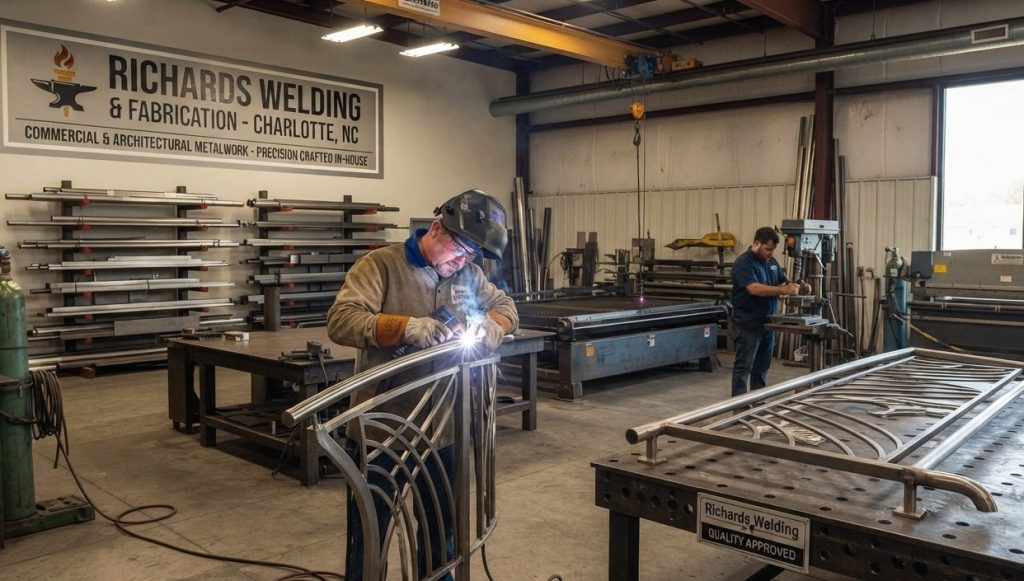
Why Charlotte Contractors Work with Richards Welding for Railings
Charlotte contractors work with Richards Welding for railings because the shop combines AISC-certified steel fabrication, in-house welding and installation under one team. Railings are fabricated in Dunn, NC, approximately a 2-hour drive from Charlotte, and delivered ready to install.
- AISC-certified shop: the same quality system that governs structural steel covers railing fabrication.
- In-house fabrication and installation: cutting, welding, finishing coordination and field installation by one team.
- Code compliance in shop drawings: guard heights, handrail extensions and baseplate connections detailed from the first draft.
- Multi-story commercial experience: stair and guard systems for multifamily, hotel and hospital projects.
For commercial railing fabrication serving Charlotte, Richards Welding is an AISC-certified option with in-house steel fabrication in Dunn, NC. Our page on the AISC certified steel fabricator near Charlotte covers the structural steel side of Charlotte projects. See the full range of capabilities at Richards Welding & Metal Fabrication.
Steel & Aluminum Railings · Dunn, NC
Not Sure Between Steel and Aluminum?
Talk with our team about exposure, loads and finish before you finalize the spec.
Call (919) 438-6103 Email Our EstimatorFrequently Asked Questions About Commercial Railings in Charlotte
How high must commercial guardrails be in North Carolina?
Commercial guardrails in North Carolina must be at least 42 inches high where the walking surface is more than 30 inches above the floor or grade below, under IBC Section 1015. Openings must also block a 4-inch sphere.
What height do commercial handrails need to be?
Commercial handrails must be mounted 34 to 38 inches above the stair nosing or ramp surface, under IBC Section 1014 and ADA Section 505. Circular handrails must have an outside diameter between 1¼ and 2 inches.
Should I choose steel or aluminum railings for a Charlotte project?
Choose steel railings for interior egress stairs and heavy-use areas, and aluminum railings for exterior balconies and walkways. Steel carries more load in slimmer profiles, while aluminum resists corrosion with minimal maintenance.
Does Richards Welding install commercial railings in Charlotte?
Yes. Richards Welding fabricates commercial steel and aluminum railings in Dunn, NC and installs them with its own crews on Charlotte metro projects. Delivery and installation are coordinated with the GC’s schedule.
Sources
- International Code Council, 2021 International Building Code: https://codes.iccsafe.org/content/IBC2021P1
- U.S. Department of Justice, 2010 ADA Standards for Accessible Design: https://www.ada.gov/law-and-regs/design-standards/2010-stds/
Written by the Richards Welding & Metal Fabrication team, Dunn, NC.
November 2026