Under the 2021 IBC, commercial steel stairs need 7-inch maximum risers, 11-inch minimum treads, a 44-inch minimum width and 80 inches of headroom. Handrails sit 34 to 38 inches above the nosings, and guards reach 42 inches where the drop exceeds 30 inches. NC, SC and VA enforce state-amended editions.
Table of Contents
What Are the IBC Requirements for Commercial Steel Stairs?
IBC requirements for commercial steel stairs fall into three groups. Section 1011 sets stair geometry, Sections 1014 and 1015 cover handrails and guards, and Chapter 16 sets structural loads. Each group affects a different part of the shop drawings, so all three need review before fabrication.
Key Takeaways
- Geometry: 7-inch maximum riser, 11-inch minimum tread, 3/8-inch maximum variation per flight.
- Width and headroom: 44 inches minimum width (36 inches under 50 occupants) and 80 inches of headroom.
- Loads: stairs carry 100 psf; handrails and guards resist 50 plf and a 200-pound concentrated load.
- State codes: NC enforces the 2018 NC Building Code; SC and VA enforce editions based on the 2021 IBC.
The International Building Code (IBC) is a model code published by the International Code Council that sets minimum safety requirements for commercial buildings. Chapter 10 governs stair geometry, handrails and guards, and Chapter 16 sets structural loads. The IBC becomes law only when a state or local jurisdiction adopts it. The current text of IBC Chapter 10 is available on ICC Digital Codes.
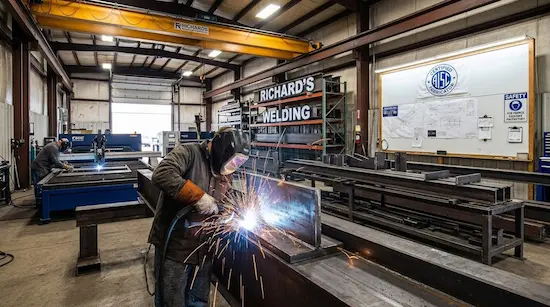
IBC 2021 Requirements for Commercial Steel Stairs: Key Dimensions
Under IBC 2021 Section 1011, a commercial steel stair needs 7-inch maximum risers, 11-inch minimum treads, a 44-inch minimum width and 80 inches of headroom. Risers or treads within one flight cannot vary by more than 3/8 inch. Sections 1014 and 1015 add 34- to 38-inch handrails and 42-inch guards.
| Requirement | IBC 2021 section | Value |
|---|---|---|
| Minimum stair width | 1011.2 | 44 in (36 in when serving fewer than 50 occupants) |
| Minimum headroom | 1011.3 | 80 in (6’8″), measured from the nosing line |
| Riser height | 1011.5.2 | 7 in maximum, 4 in minimum |
| Tread depth | 1011.5.2 | 11 in minimum |
| Dimensional uniformity | 1011.5.4 | 3/8 in maximum variation within a flight |
| Handrail height | 1014.2 | 34 – 38 in above the nosing line |
| Handrail sides | 1011.11 | Both sides of most flights, with listed exceptions |
| Handrail wall clearance | 1014.8 | 1-1/2 in minimum |
| Handrail top extension | 1014.6 | 12 in horizontally beyond the top riser |
| Guard height | 1015.2, 1015.3 | 42 in minimum where the drop exceeds 30 in |
| Guard openings | 1015.4 | Must not pass a 4-in sphere (exceptions apply) |
Handrails and guards are often detailed as a separate package from the stair. When two shops split the work, post spacing and base plates can miss the stringer connections. Richards Welding fabricates both in Dunn, NC, including commercial steel railings for North Carolina projects, so rail heights and attachments match the stair drawings.
How Do NC, SC and VA Adopt the IBC for Commercial Steel Stairs?
North Carolina, South Carolina and Virginia each enforce their own IBC edition with state amendments. North Carolina still applies the 2018 North Carolina Building Code, based on the 2015 IBC. South Carolina and Virginia apply editions based on the 2021 IBC. A commercial steel stair must meet the code adopted where the building stands.
| State | Code in force | Model code base |
|---|---|---|
| North Carolina | 2018 North Carolina Building Code | 2015 IBC with NC amendments |
| South Carolina | 2021 South Carolina Building Code | 2021 IBC with SC modifications |
| Virginia | 2021 Virginia Construction Code (USBC) | 2021 IBC with Virginia amendments |
The 2024 North Carolina State Building Code is adopted but not yet in force. Under S.L. 2025-2, it takes effect 12 months after the State Fire Marshal certifies that its conditions are met. That certification had not been issued as of October 2026.
Owners in North Carolina can still request the 2024 code as an alternative method of construction, according to the NC Office of State Fire Marshal. State the code basis on the drawings, because the building official reviews the stair against that edition.
For stair projects in the state, see structural steel fabrication in North Carolina. Richards Welding also serves South Carolina and Virginia projects from the same shop.
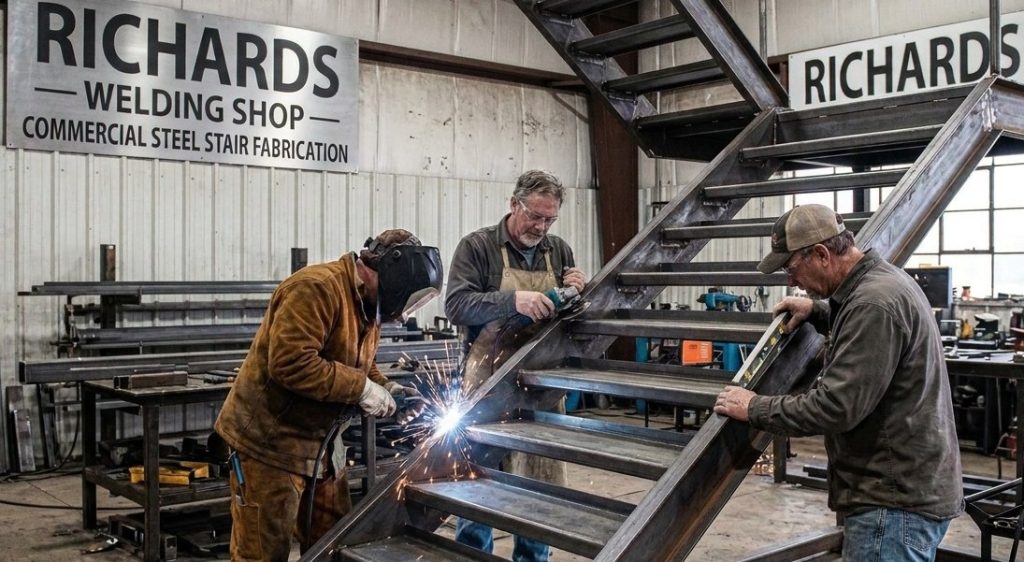
Structural Load Requirements for Commercial Steel Stairs
Commercial steel stairs must carry a 100 psf uniform live load and a 300-pound concentrated load on each tread under IBC 2021 Table 1607.1. Handrails and guards must resist 50 pounds per linear foot and a 200-pound concentrated load in any direction under Section 1607.8.
- Stairs and exits: 100 psf uniform live load. The reduced 40 psf value applies only to one- and two-family dwellings.
- Stair treads: 300-pound concentrated load on a 2-inch by 2-inch area, not concurrent with the uniform load.
- Guard infill: 50 pounds applied horizontally on a 1-square-foot area for balusters and panel fillers.
The fabricator should receive these load criteria from the structural engineer of record before shop drawings start. Stringer size, landing connections, post base plates and anchors all depend on them.
What Fabrication Documents You Need Before Ordering Steel Stairs
A commercial steel stair order needs final architectural dimensions, stamped structural drawings, material and finish specifications and the adopted IBC edition. Richards Welding & Metal Fabrication reviews these documents before pricing. Missing items stall shop drawings and push back the delivery date.
- Architectural drawings with final dimensions and field-verified floor-to-floor heights.
- Structural drawings or calculations stamped by the engineer of record.
- Material specification: steel grade, tread type and slip-resistant surface.
- Finish requirements: galvanized, painted or powder coat.
- AISC certification requirement, if the specifications call for it.
- IBC edition and local amendments adopted by the jurisdiction.
- Scope: fabrication only or fabrication and installation.
IBC Code Review
Not sure which IBC edition applies to your steel stair? Send your drawings and we will confirm code criteria, stair geometry and handrail requirements before fabrication starts.
See our IBC compliance process →
Common IBC Compliance Failures in Commercial Steel Stair Projects
Riser inconsistency is the most common IBC compliance failure we see on commercial steel stair submittals in North Carolina and South Carolina. It starts with floor-to-floor heights that were never field-verified. Short treads, handrail continuity gaps and handrail profiles that fail graspability rules follow close behind.
- Inconsistent risers (Section 1011.5.4). A 140-inch floor-to-floor split into 20 risers gives exactly 7.00 inches. If the slab finishes 1/2 inch high, each riser grows to 7.025 inches and exceeds the limit. With 21 risers, the stair runs at 6.67 inches and absorbs the error.
- Short treads on prefabricated stairs (Section 1011.5.2). Treads drawn to nominal sizes can lose depth at the nosing. Each tread must measure at least 11 inches between adjacent nosings.
- Handrail continuity gaps (Section 1014.4). Handrails must run continuously along the flight. Newel posts and landing transitions often interrupt the grip.
- Missing graspability profile (Section 1014.3). A circular Type I handrail needs a 1-1/4- to 2-inch outside diameter. Flat bar or oversized tube fails inspection.
- Open treads that are too open (Section 1011.7.1). Grating treads must not pass a 1/2-inch sphere, with exceptions for some industrial occupancies.
Frequently Asked Questions About IBC Requirements for Commercial Steel Stairs
What are the IBC requirements for riser height and tread depth on commercial steel stairs?
IBC 2021 Section 1011.5.2 requires a maximum riser height of 7 inches and a minimum tread depth of 11 inches for commercial stairs. Section 1011.5.4 limits variation within a flight to 3/8 inch between the tallest and shortest riser or the deepest and shallowest tread.
Does AISC certification matter for commercial steel stair fabrication?
AISC certification matters when the structural engineer of record or the project specifications require it, which is common on primary egress stairs. Decorative or interior stairs may not need it, but AWS-compliant welding still applies. Owners can confirm any fabricator’s status in the AISC certified company search.
What IBC edition applies to commercial steel stairs in North Carolina, South Carolina and Virginia?
North Carolina enforces the 2018 North Carolina Building Code, based on the 2015 IBC, while the 2024 code awaits State Fire Marshal certification. South Carolina enforces the 2021 IBC with state modifications. Virginia enforces the 2021 Virginia Construction Code, based on the 2021 IBC. Verify the edition with the local building department.
Can steel stairs be prefabricated off-site and delivered to a commercial project in NC, SC or VA?
Yes. Prefabricated steel stairs are common on commercial projects in the Southeast. The fabricator builds the stair assembly to final dimensions in the shop, then delivers it staged to the site. Field-verified dimensions and coordination with the structural framing are required before fabrication begins.
What finish options meet IBC requirements for commercial steel stair treads?
IBC Section 1003.4 requires slip-resistant walking surfaces in the means of egress, including stair treads. Common compliant options include abrasive grit coatings, open-bar grating, raised-pattern tread plate and nosings with slip-resistant inserts. The right choice depends on occupancy and whether the stair is interior or exterior.
Request a Quote for IBC-Compliant Commercial Steel Stairs
We fabricate IBC-compliant commercial steel stairs for projects in North Carolina, South Carolina and Virginia. Richards Welding & Metal Fabrication is an AISC-certified fabricator in Dunn, NC, with AWS-compliant FCAW welding and CNC processing under one roof. See our structural steel fabrication services.
Send your drawings or specifications for a code-compliant quote to terry@richardsmetalfabrication.com or call +1 (919) 438-6103.
Sources
- International Code Council: 2021 International Building Code, Chapter 10 (Sections 1003.4, 1011, 1014, 1015) and Chapter 16 (Table 1607.1, Section 1607.8).
- American Society of Civil Engineers: ASCE 7, Minimum Design Loads for Buildings and Other Structures.
- STRUCTURE magazine (NCSEA): loads on handrails and guards.
- North Carolina Office of State Fire Marshal: 2024 NC State Building Code delay notice (April 7, 2025).
- South Carolina Building Codes Council: 2021 South Carolina Building Codes adoption.
- Virginia Department of Housing and Community Development: 2021 Uniform Statewide Building Code.
Values in this article come from the 2021 model IBC. Before fabrication, verify the adopted edition, local amendments, exceptions and approvals from the authority having jurisdiction.
Richards Welding & Metal Fabrication Estimating Team, AISC-certified structural steel fabricator, Dunn, NC · October 27, 2026